
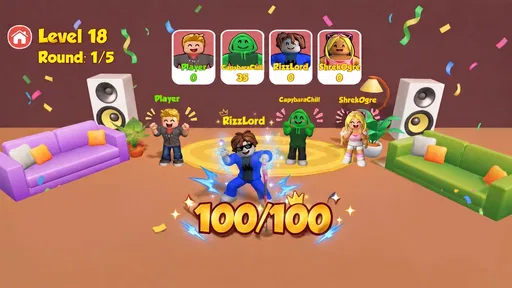
MemeMix Challenge: Funny Party review
 Analysis by GetAllApps
I like party games that get people involved within seconds, and MemeMix Challenge: Funny Party is built around a simple invitation: mimic a funny sound, see how you score, then challenge your friends to try it too. That premise gives the game an easy social hook without asking players to learn a complicated ruleset first. It is a casual game from Amobear VN Game Global, and its playful focus makes it a natural pick for a relaxed get-together or a quick break when everyone wants a little silliness.
What makes the first turn fun
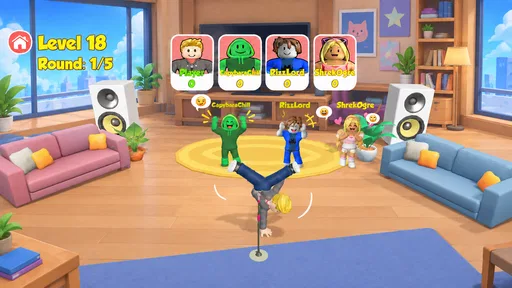
The first action is the whole point: listen to a sound and try to imitate it. Rather than relying on long instructions or a deep strategy, MemeMix Challenge puts the performance front and center. You make the sound, wait for the game’s response, and find out how your attempt scored. That quick exchange is easy to understand even for someone who has only just joined in.
I find that kind of immediate premise useful in a party setting. Nobody needs to be an experienced gamer to take part, and the idea itself encourages people to loosen up. A convincing imitation might earn a pleased reaction, while an offbeat attempt can be funny for an entirely different reason. Either way, the player has done something rather than simply watching someone else play.
The game’s store description sums up the basic appeal neatly: mimic funny sounds, get scored, and challenge your friends. That is also a good expectation to bring into a session. The fun is rooted in performance and reaction, not in a promise of elaborate progression. If your group enjoys silly voices, exaggerated noises, and laughing together at imperfect attempts, the central idea should make sense right away.
A casual game with a social hook
As a casual party game, MemeMix Challenge is most appealing when the people around you are willing to join the joke. Sound imitation is naturally expressive: players can commit to a performance, try to match what they heard, or deliberately make their attempt ridiculous. The challenge keeps the activity focused, while the social setting gives each turn its own personality.
The game is free to play, with in-app purchases listed at $1.99 per item. It is rated Everyone, which fits the broad, lighthearted framing of the experience. Those details make it easier to see where the game sits: an accessible option for casual play, rather than a heavyweight title built around lengthy sessions or complicated systems.
Its audience numbers also suggest that the concept has found plenty of curious players. MemeMix Challenge has passed five million installs and has an average rating of 4.3 from around three and a half thousand ratings. Those figures can offer a little context when browsing for a new game, but what matters in the moment is whether your own group enjoys taking turns and hearing each other’s attempts.
The rhythm of trying, scoring, and laughing
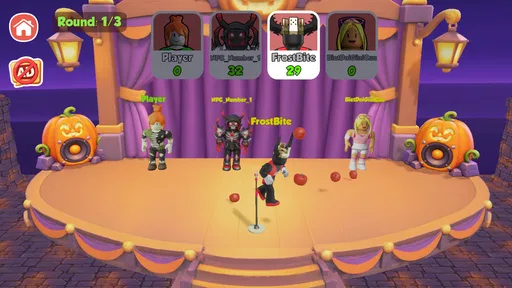
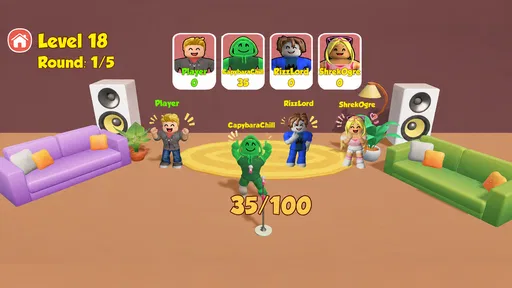
The core rhythm is easy to follow: make an imitation, receive a score, and decide whether to have another go. That feedback arrives at the moment players are already paying attention, so each attempt has a small payoff. You do not need to wait through a lengthy setup to find out how the performance landed. The score gives the turn a clear endpoint and gives the next player a reason to step in.
Scoring also adds a light competitive edge. Friends can compare attempts, tease one another in good spirit, and see who can make the most convincing sound. Just as importantly, the system gives players a shared reference point. Even a short turn becomes something everyone can react to: the effort, the result, and the moment the next person decides to beat it.
I like that the premise leaves room for different kinds of fun. A player who wants to do their best can treat each turn as a small performance challenge. Someone who is less concerned with accuracy can lean into the comedy instead. The game’s basic action supports both approaches, which helps keep the mood relaxed rather than making every round feel like a serious test.
Feedback that keeps the group involved
In a social game, feedback is more than a number on a screen; it helps carry the conversation from one person to the next. Here, the score gives the group something immediate to discuss. Did that attempt sound close? Was the impression unexpectedly funny? Who wants to try again? That chain of reactions is the real engine behind the game’s party appeal.
The store summary also highlights challenging friends, which points toward the experience’s most natural use: passing the fun around rather than treating it as a solitary task. A challenge can turn one person’s turn into an invitation for another. The result is a simple back-and-forth where each attempt creates a fresh comparison and a new chance to get a laugh.
That rhythm works best when players are happy to perform in front of one another. If a group prefers quiet, individual play, the social premise may have less room to shine. But with friends who enjoy playful competition, the score can prompt a second attempt almost by itself. Someone sees how another player did and wants to find out whether they can do better, or at least make the room laugh harder.
Why a reward can lead to another attempt
The reward here is not something complicated to explain. It is the combination of seeing how an imitation scored and getting a reaction from the people around you. A strong attempt offers a small moment of triumph; a funny failure can be just as satisfying because it gives everyone a reason to laugh. The game turns a brief performance into a shared payoff.
That matters because not every casual game needs a large set of unlocks or a long-term goal to encourage another round. In MemeMix Challenge, the immediate result is tied to the action you just took. You imitate, you see the score, and you can compare your result with a friend’s. That short feedback loop gives the next turn a clear purpose without making the premise hard to follow.
The challenge element also makes repetition feel natural. Once one person has tried a sound, another player may want their own go. If the score leaves room for improvement, the first player might try again as well. The motivation comes from the group’s curiosity and the simple desire to top a previous attempt, rather than from needing to study a complex set of mechanics.
Easy to pick up, shaped by the room
Because the central action is immediately understandable, the game can fit into a casual gathering without demanding that everyone commit to a long session. Someone can join for a turn, see how the scoring works, and decide whether they want another. That low barrier is a practical strength for a party title: the game can support an informal mood instead of taking over the whole evening.
The experience will naturally vary from group to group. With outgoing friends, the imitations may become increasingly theatrical, and the scores may spark friendly rivalries. With a quieter crowd, turns may be more restrained, but the simple format still gives everyone a clear action to try. The game provides the prompt and feedback; the players bring the personalities that make the session memorable.
That dependence on the group is worth keeping in mind. MemeMix Challenge is not trying to replace a deep solo game, and its central idea is at its best when people are ready to participate. If your preferred kind of entertainment is thoughtful planning or a story-driven adventure, this may not be the right fit. If you want a straightforward way to get friends laughing and competing, its focus is much more promising.
Resetting the session without losing the mood
After a score, the natural reset is simply to let the next player take a turn or give the previous player another chance. That keeps the session moving back toward the central action instead of requiring a fresh explanation every time. Each turn is self-contained enough to be understood on its own, while the score and the social reactions carry a little momentum forward.
This is where the game’s loop feels especially tidy. The imitation is the action, the score is the feedback, the group’s response is the reward, and the next attempt resets the activity with a new performance. That structure makes the game easy to revisit during a get-together: the reason to continue is right there in the room, as friends compare results and dare one another to try.
A quick reset also suits a game meant for casual play. Players can take turns without needing to build a complicated plan between rounds. Each new attempt offers a small change in performer and delivery, and that alone can alter the mood. Even when the basic activity stays the same, different personalities make the next turn feel like its own little moment.
Who should give it a try
I would point MemeMix Challenge toward players who enjoy expressive, low-pressure competition. It is a good match for friends who like doing impressions, making ridiculous noises, or laughing at the gap between an intended performance and the final result. The game’s appeal is less about mastering a broad system and more about sharing a quick challenge that everyone can understand.
It may also suit people looking for a family-friendly option, since its content rating is Everyone. The important ingredient is still enthusiasm: the best session is likely to come from a group willing to take a turn rather than sit back and watch. When that willingness is there, the simple action-and-score format gives the gathering a ready-made activity.
For anyone checking compatibility, the listed minimum operating system is version 7.1, and the current version is 0.0.9. The game was released on September 18, 2026. Those details help identify the version and release information while you decide whether to try it, though the essential question remains a personal one: does your group enjoy making sounds and seeing who can pull them off?
My take on the full loop
MemeMix Challenge: Funny Party keeps its promise focused. You mimic a funny sound, receive a score, and challenge friends to join the fun. The action is easy to explain, the feedback comes right after the attempt, and the reward is a mix of comparison and shared laughter. Then the session resets naturally as another player takes a turn or someone tries again.
That loop is the game’s strongest idea. It gives every participant a clear role and makes each attempt short enough to keep the group engaged. The format does not need a complicated explanation to create a playful contest, and the score adds just enough structure to turn spontaneous silliness into a challenge. In my view, that makes it a sensible pick for a relaxed social session, especially when friends are happy to be a little ridiculous.
MemeMix Challenge is best approached as a light, social experience rather than a deep game with a long list of systems. Its strengths come from the simple premise and from what players bring to it: confidence, comic timing, and a willingness to take another turn. If you are after an easygoing sound imitation game that can give friends a reason to compete and laugh together, this one is worth considering. Its loop is straightforward, but that is also why another round can begin so easily.
Pros and cons
Pros
- Quick rounds make it easy to play between other activities.
- A playful format gives casual gatherings a simple icebreaker.
- Players can create funny moments without advanced gaming skills.
- The challenge format encourages friendly competition.
- Its lighthearted theme suits groups looking for a casual party game.
Cons
- The fun depends on having other people available to play.
- Repeated prompts may feel familiar after several sessions.
- Humor can vary widely between players.
- Some challenges may not suit every age group.
- The experience may offer limited appeal to solo players.


